Callidulidae, the only known family of the superfamily Calliduloidea, is the family of Old World butterfly-moths, containing eight genera. They have a peculiar distribution, restricted to the Old World tropics of South East Asia to Australasia and Madagascar. The three subfamilies exhibit both day- and night-flying behaviour.
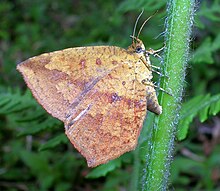

The mainly day-flying Callidulinae can be distinguished by their resting posture, which is the most butterfly-like, with the wings held closely over the back. Resembling the butterfly family Lycaenidae, these moths can be told apart by their antennae which taper to a point or may be very subtly clubbed. The more often night-flying Pterothysaninae and Griveaudiinae have a different adult resting posture (the latter roof-like in repose) and these were not placed within the Callidulidae until recently.[1]
Biology of most subfamilies and species is poorly known. Eggs are very flat in Griveaudiinae and Callidulinae, and caterpillars of Callidulinae are green with a shiny black head and have only been reported from ferns[2] forming a leaf roll in which they live, eat and finally pupate, while the pupa of Helicomitra appears to be subterranean.[3]
The closest relatives of Callidulidae are not known, but they are currently placed in a group that includes the three butterfly superfamilies, the "hook-tip moths" Drepanoidea and the "geometer moths" Geometroidea and also possibly Axioidea which share some structural characteristics.[4]