The geometer moths are moths belonging to the family Geometridae of the insect order Lepidoptera, the moths and butterflies. Their scientific name derives from the Ancient Greek geo γεω (derivative form of γῆ or γαῖα "the earth"), and metron μέτρον "measure" in reference to the way their larvae, or "inchworms", appear to "measure the earth" as they move along in a looping fashion.[1] A very large family, it has around 23,000 species of moths described,[2][3] and over 1400 species from six subfamilies indigenous to North America alone.[1] A well-known member is the peppered moth, Biston betularia, which has been subject of numerous studies in population genetics. Several other geometer moths are notorious pests.


Adults
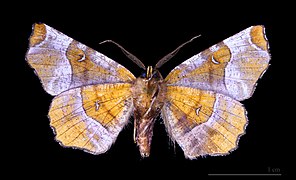
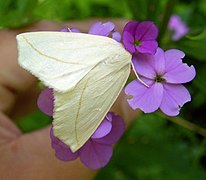
Many geometrids have slender abdomens and broad wings which are usually held flat with the hindwings visible. As such, they appear rather butterfly-like, but in most respects they are typical moths; the majority fly at night, they possess a frenulum to link the wings, and the antennae of the males are often feathered. They tend to blend into the background, often with intricate, wavy patterns on their wings. In some species, females have reduced wings (e.g. winter moth and fall cankerworm).[1] Most are of moderate size, about 3 cm (1.2 in) in wingspan, but a range of sizes occur from 10–50 mm (0.39–1.97 in), and a few (e.g., Dysphania species) reach an even larger size. They have distinctive paired tympanal organs at the base of the abdomen (lacking in flightless females).[citation needed]

Caterpillars
The name "Geometridae" ultimately derives from Latin geometra from Greek γεωμέτρης ("geometer", "earth-measurer"). This refers to the means of locomotion of the larvae or caterpillars, which lack the full complement of prolegs seen in other caterpillars, with only two or three pairs at the posterior end instead of the usual five pairs. Equipped with appendages at both ends of the body, a caterpillar clasps with its front legs and draws up the hind end, then clasps with the hind end (prolegs) and reaches out for a new front attachment - creating the impression that it measures its journey. The caterpillars are accordingly called "loopers", "spanworms", or "inchworms" after their characteristic looping gait. The cabbage looper and soybean looper are not inchworms, but caterpillars of a different family. In many species of geometer moths, the inchworms are about 25 mm (1.0 in) long. They tend to be green, grey, or brownish and hide from predators by fading into the background or resembling twigs. Many inchworms, when disturbed, stand erect and motionless on their prolegs, increasing the resemblance. Some have humps or filaments, or cover themselves in plant material. They are gregarious and are generally smooth. Some eat lichen, flowers, or pollen, while some, such as the Hawaiian species of the genus Eupithecia, are carnivorous. Certain destructive inchworms are called cankerworms.[citation needed]
In 2019, the first geometrid caterpillar in Baltic amber was discovered by German scientists. Described under Eogeometer vadens, it measured about 5 mm (0.20 in), and was estimated to be 44 million years old, dating back to Eocene epoch. It was described as the earliest evidence for the subfamily of Ennominae, particularly the tribe of Boarmiini.[4]



Systematics
The placement of the example species follows a 1990 systematic treatment; it may be outdated. Subfamilies are tentatively sorted in a phylogenetic sequence, from the most basal to the most advanced. Traditionally, the Archiearinae were held to be the most ancient of the geometer moth lineages, as their caterpillars have well-developed prolegs. However, it now seems that the Larentiinae are actually older, as indicated by their numerous plesiomorphies and DNA sequence data. They are either an extremely basal lineage of the Geometridae – together with the Sterrhinae –, or might even be considered a separate family of Geometroidea. As regards the Archiearinae, some species that were traditionally placed therein actually seem to belong to other subfamilies; altogether it seems that in a few cases, the prolegs which were originally lost in the ancestral geometer moths re-evolved as an atavism.[5][6]
Larentiinae – about 5,800 species, includes the pug moths, mostly temperate, might be a distinct family[5][6]
Sterrhinae – about 2,800 species, mostly tropical, might belong to same family as the Larentiinae[5]
- Birch mocha, Cyclophora albipunctata
- False mocha, Cyclophora porata
- Maiden's blush, Cyclophora punctaria
- Riband wave, Idaea aversata
- Small fan-footed wave, Idaea biselata
- Single-dotted wave, Idaea dimidiata
- Small scallop, Idaea emarginata
- Idaea filicata
- Dwarf cream wave, Idaea fuscovenosa
- Rusty wave, Idaea inquinata
- Purple-bordered gold, Idaea muricata
- Bright wave, Idaea ochrata
- Least carpet, Idaea rusticata
- Small dusty wave, Idaea seriata
- Purple-barred yellow, Lythria cruentaria (formerly in Larentiinae)
- Vestal, Rhodometra sacraria
- Common pink-barred, Rhodostrophia vibicaria
- Middle lace border, Scopula decorata
- Cream wave, Scopula floslactata
- Small blood-vein, Scopula imitaria
- Lewes wave, Scopula immorata
- Lesser cream wave, Scopula immutata
- Mullein wave, Scopula marginepunctata
- Zachera moth, Chiasmia defixaria
- Blood-vein, Timandra comae
- Eastern blood-vein, Timandra griseata
Desmobathrinae – pantropical
Geometrinae – emerald moths, about 2,300 named species, most tropical
Archiearinae – 12[verification needed] species; holarctic, southern Andes and Tasmania, though the latter some seem to belong to the Ennominae,[6] larvae have all the prolegs except most are reduced.
- Infant, Archiearis infans (Möschler, 1862)
- Scarce infant, Leucobrephos brephoides (Walker, 1857)
Oenochrominae – in some treatments used as a "wastebin taxon" for genera that are difficult to place in other groups
Alsophilinae – a few genera, defoliators of trees, might belong in the Ennominae, tribe Boarmiini[6]
- March moth, Alsophila aescularia
- Fall cankerworm, Alsophila pometaria
Ennominae – about 9,700 species, including some defoliating pests, global distribution
- †Eogeometer vadens[4]
Geometridae genera incertae sedis include:
- Dichromodes
- Homoeoctenia
- Nearcha
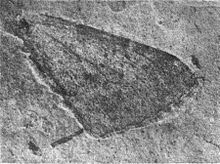
Fossil Geometridae taxa include:
- †Eogeometer Fischer, Michalski & Hausmann, 2019[4]
- †Hydriomena? protrita Cockerell, 1922 (Priabonian, Florissant Formation, Colorado)[7]
- †Geometridites Clark et al., 1971